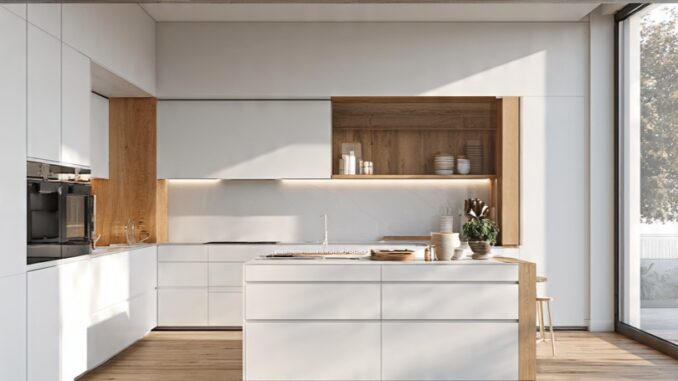
Less visual noise, more function. How to do minimalist without feeling cold or empty

Minimalist doesn’t mean white and empty. It means intentional. Every line, material, and object has a job. In a minimalist kitchen, you remove clutter so the architecture, light, and a few great materials can shine.

Here are 27 design ideas for a clean, modern, minimalist kitchen. The goal: calm, not sterile.

The 3 Pillars of Minimalist Kitchens
-
Hidden function: Storage, appliances, and venting disappear so surfaces stay clear. -
Material honesty: Use 2-3 materials max. Let them be the star. -
Negative space: The empty space is as important as the objects. Don’t fill every wall.
Layout & Cabinet Designs

1. Handleless Cabinets with Push-to-Open or Integrated Channel

Why it’s minimalist: No hardware = no visual interruptions. The cabinets read as a flat plane.
How to do it: J-pull, C-channel, or tip-on hardware. Best on flat-slab doors.
Tip: Put a small finger pull on trash and heavy drawers. You’ll thank yourself.

2. Full-Height, No-Upper Wall

Why it’s minimalist: Upper cabinets = visual clutter. Do floor-to-ceiling pantry on one wall, nothing on the other.
How it works: All storage is in the pantry and base drawers. The open wall gets art or just negative space.
Need: 60"+ of pantry width to replace uppers.

3. Single Material for All Cabinets

Why it’s minimalist: No island in different color. No glass uppers. One material, top to bottom.
Best materials: Matte white lacquer, natural white oak, or dark charcoal Fenix.
Effect: The kitchen becomes a monolith, calm and sculptural.

4. Flush Panel-Ready Appliances

Why it’s minimalist: No stainless breaks the plane. Fridge, dishwasher, and even oven panels match cabinets.
Key detail: True flush install, not overlay. The doors sit in plane with cabinets.
Brands: Sub-Zero, Miele, Fisher & Paykel do it best.

5. No Toe Kick

Why it’s minimalist: Cabinets go to the floor with a shadow gap or float 6" off the floor.
Effect: Feels like furniture, not kitchen. Looks custom.
Trade-off: You can’t stand as close. Use for island or one run, not everywhere.

6. Vertical Grain Matching

Why it’s minimalist: Wood grain runs continuously across all doors and drawers.
Effect: Reads as one piece of wood, not boxes. Dead quiet visually.
Cost: More labor, more waste. Worth it in small kitchens.

7. Appliance Wall Only

Why it’s minimalist: All tall stuff — fridge, ovens, pantry — on one wall. Everything else is low and horizontal.
Effect: From the living room, you see a clean, low line. The “kitchen” disappears.
Layout: Galley or L-shape works best.

Counters, Backsplash & Surfaces

8. Zero-Overhang Waterfall Island

Why it’s minimalist: No overhang = no stools = no visual clutter. The island is sculpture.
How it works: Use the island for prep only. Put seating at a real table elsewhere.
Material: One slab of quartz, porcelain, or sintered stone, mitered edges.

9. Integrated Sink + Counter

Why it’s minimalist: Sink is the same material as counter. No seam, no stainless rim.
Materials: Corian, Hi-Macs, stainless steel, or porcelain.
Look: Ultra-clean. Crumbs wipe straight in.
Note: Can’t be done with natural stone.

10. Full-Height Slab Backsplash, No Uppers

Why it’s minimalist: One material from counter to ceiling. No grout, no shelves, no outlets if you plan it.
Best stone: Quiet quartzite, porcelain with subtle veining, or plain plaster.
Outlets: Use under-cabinet strips or pop-up if you must.

11. No Backsplash

Why it’s minimalist: Painted drywall or plaster behind the range and sink.
How it works: You need a great hood and you must be a clean cook. It’s the ultimate reduction.
Effect: The wall is the wall. Nothing to look at.

12. Thin 1/2" Counter Profile

Why it’s minimalist: Chunky 3" counters feel heavy. 1/2" porcelain or sintered stone feels light.
Support: Needs plywood subtop. Not for everyone, but killer in modern spaces.
Edge: Sharknose or pencil, never ogee.

13. Concrete or Microcement Throughout

Why it’s minimalist: Floors, counters, and even walls in the same cement finish.
Effect: Zero transitions. The room is one continuous form.
Seal it: Microcement is sealed and warm to touch, unlike raw concrete.

Hoods, Sinks & Details

14. Downdraft or Ceiling-Mount Vent

Why it’s minimalist: No hood interrupting the line of cabinets or view.
How it works: Pop-up downdraft behind cooktop, or 3" thick ceiling unit.
Reality: Less effective than a hood. Only if you don’t fry or sear often.

15. Integrated Plaster Hood

Why it’s minimalist: Hood is part of the wall, not a stainless object.
Finish: Same plaster or paint as walls. You see the shape, not the material.
Shape: Simple taper or box. No corbels or curves.

16. Single Faucet, No Sprayer

Why it’s minimalist: One hole, one form. A tall, sculptural faucet is all you need.
Best types: Boffi, Vola, or Dornbracht. They’re designed as objects.
Function: Get high pressure so you don’t miss the sprayer.

17. Track Drain Sink

Why it’s minimalist: The drain is a slot at the back. The sink bottom is flat and clean.
Bonus: Cutting board and colander accessories slide on the track, then hide.
Material: Stainless or Corian for full integration.

18. No Cabinet Crown or Trim

Why it’s minimalist: Cabinets die into the ceiling with a 1/2" shadow gap.
Effect: No visual stop. The ceiling feels higher.
Need: Perfectly flat ceilings or a skilled carpenter.

Lighting That Disappears

19. Recessed Lighting Only, 4" Pinhole

Why it’s minimalist: No pendants, no chandeliers. Light with no fixture.
How to do it: 4" regressed LED, 30-36" off walls to wash cabinets. Dimmers mandatory.
Warmth: 2700K, 95 CRI. If it looks blue, you failed.

20. Hidden LED in Reveal or Cove

Why it’s minimalist: Light comes from architecture, not a thing.
Where: In a 1" gap between upper cabinets and ceiling, or behind a floating shelf.
Effect: The ceiling glows. You don’t see the source.

21. One Linear Pendant, Not Three

Why it’s minimalist: One 48-60" line vs. multiple dots.
Form: Thin, black, or white. No shades, no bulbs visible.
Height: 30-36" above island. It should feel like a line in space.

22. No Under-Cabinet Light If Slab Backsplash

Why it’s minimalist: Let the slab be clean. If you need task light, use a relocatable LED bar during cooking, then hide it.
Compromise: Mill a 1/2" channel in the underside of uppers for tape light. Zero glare.

Color, Material & Styling

23. Two-Material Rule

Why it’s minimalist: More than 3 materials = busy.
Formula: 1 cabinet material + 1 counter material. Floor can match one of them.
Examples: White oak cabinets + white quartz. Black Fenix + gray porcelain.
Metal: Your faucet is a material. Count it.

24. Matte Everything

Why it’s minimalist: Gloss reflects and creates visual noise. Matte absorbs light and feels calm.
Do it: Matte cabinets, honed counter, matte faucet, matte floor.
Exception: One polished element like a faucet can be the jewel.

25. Hidden Outlets

Why it’s minimalist: Outlets break a backsplash.
Options: Under-cabinet strip, Legrand Adorne under-cabinet, or pop-up in counter.
Code: You still need them every 4 ft. Plan early with electrician.

26. Open Shelf with One Object

Why it’s minimalist: If you do open shelves, do one 48" shelf with 1-3 objects.
Objects: A single ceramic vessel, a stack of 3 bowls, a plant.
Negative space: 70% of the shelf should be empty.

27. Clear Counters as a Rule

Why it’s minimalist: The design isn’t minimalist if counters are covered.
How to do it: Every small appliance gets a home in an appliance garage or pantry.
Daily reset: 2 minutes at night. If you can’t keep it clear, minimalist isn’t for you.

What to Avoid in Minimalist Kitchens
-
Shaker with visible grain: Too busy. Go flat slab if you want minimal. -
Busy stone: Heavy veining fights minimalism. Use quiet quartzite or solid color. -
Mixed metals everywhere: Pick one metal finish and stick to it. -
Decorative tile: No mosaics, no patterns. If you use tile, it’s 24x48 plain. -
Stainless steel overload: Fridge + range + hood + sink + microwave = commercial kitchen. Panel it.
Minimalist vs. Cold: How to Add Warmth
|
If It Feels Cold, Add |
Why It Works |
|---|---|
|
Wood |
White oak on island or shelf warms white instantly |
|
Texture |
Fluted cabinets, plaster walls, or linen shades |
|
Living finish |
Unlacquered brass ages and adds life |
|
One plant |
Organic shape breaks up hard lines |
|
Low light |
Dimmers at 20% = instant cozy, not office |
Budget: Where Minimalism Gets Expensive
|
Element |
Why It Costs More |
Cheaper Alt |
|---|---|---|
|
Flush inset panels |
Perfect reveals, skilled labor |
Overlay, but keep it flat slab |
|
Integrated appliances |
Panel cost + install |
Stainless, but hide behind pantry door |
|
Slab backsplash |
Material + templating + install |
Large-format porcelain, 24×48 |
|
Push-to-open |
Hardware + adjustments |
Slim edge pull, still minimal
|
Leave a Reply