Minimalist living rooms got a bad reputation for a while. People think “cold,” “empty,” or “you can’t actually live here.” Real minimalism isn’t about deprivation. It’s about intention. Every piece has a purpose, every surface has room to breathe, and the whole space feels calm because there’s no visual noise.

The best minimalist rooms are warm, comfortable, and deeply personal — they’re just edited. If your living room feels chaotic or you’re craving a visual reset, these 30 designs break down how to do minimalism right. You don’t need to throw everything out and paint it all white. You just need to be selective.

What Minimalism Is Actually About in 2026

Forget the 2015 version: all-white, no personality, nothing on the walls. Modern minimalism is “warm minimalism,” “Japandi,” and “organic minimal.” It allows texture, natural materials, and objects you love. The rule: if it doesn’t serve a function or bring you joy, it doesn’t stay.

Clean space = clean mind. Let’s get into the designs.

Foundational Minimalist Layouts

1. The One-Sofa Room
Key features: Single low-profile sofa, one coffee table, one floor lamp, one art piece. That’s it.
Why it works: Negative space is the main feature. When you limit furniture, each piece looks sculptural.
Copy it: Remove one seat from your current setup for a week. See if you miss it.

2. Symmetry That Calms
Key features: Sofa centered on wall, matching side tables, matching lamps, centered art.
Why it works: The human brain loves symmetry. It reads as orderly and quiet without trying.
Copy it: You don’t need matching furniture — just match the visual weight on each side.

3. The Perimeter Plan
Key features: All furniture pushed to walls, wide open center, large rug anchoring.
Why it works: Maximizes open floor space. Great for yoga, kids playing, or small spaces.
Copy it: Best if you don’t watch much TV. If you do, mount it and skip the console.

4. Conversational Circle
Key features: 4 identical lounge chairs around a round coffee table. No sofa.
Why it works: It’s democratic, balanced, and removes the “main seat” hierarchy.
Copy it: Works best in square rooms. Use swivel chairs so you can pivot to a TV if needed.

5. The Window Worshipper
Key features: Seating faces the window, not a TV. No media unit at all.
Why it works: Prioritizes light and view over screens. The room feels bigger instantly.
Copy it: If you must have a TV, use a Frame TV or projector that disappears.

Color Palette Minimalist Designs

6. Warm White Monochrome
Key features: Walls, sofa, rug, curtains all in shades of warm white, cream, and oat.
Why it works: Tone-on-tone is restful. Texture keeps it from being flat.
Copy it: Mix 3–4 shades of white and at least 3 textures: bouclé, linen, wool, plaster.

7. Greige Sanctuary
Key features: Greige walls, taupe sofa, light oak, black accents.
Why it works: Greige = gray + beige. It’s softer than gray, modern than beige. The perfect neutral.
Copy it: Paint color: Benjamin Moore “Balboa Mist” or Sherwin Williams “Accessible Beige.”

8. Black & White Graphic
Key features: Crisp white walls, black frame windows, black media unit, white sofa.
Why it works: High contrast is bold but still minimalist because there are only 2 colors.
Copy it: Use black in thin lines only — frames, lamp base, coffee table legs. Keep it 10% of the room.

9. Earth Tone Minimal
Key features: Clay walls, sand sofa, terracotta pot, wood beams. No bright colors.
Why it works: Colors pulled from nature are inherently calming and don’t visually shout.
Copy it: Stick to colors you’d find in the desert: sand, clay, stone, muted green.

10. All-Tonal Beige Layering
Key features: 5 shades of beige from light to dark. Zero contrast colors.
Why it works: The eye moves smoothly around the room. It feels expensive and quiet.
Copy it: Start with your rug as the darkest tone, sofa as mid-tone, walls as lightest.

Material-Driven Minimalist Designs

11. Linen & Oak Only
Key features: Natural oak floors, linen sofa, linen curtains, oak coffee table. No metal, no paint.
Why it works: Limiting materials to 2 makes the room feel cohesive without effort.
Copy it: If you rent, bring in linen via pillows and curtains, oak via a tray or side table.

12. Bouclé + Travertine
Key features: Bouclé curved sofa, travertine coffee table, plaster walls. Cream palette.
Why it works: Bouclé and stone are the textures of warm minimalism. They’re soft and hard, nubby and smooth.
Copy it: A bouclé accent chair + travertine side table gives the look for less.

13. Concrete & Wool
Key features: Polished concrete floors, wool area rug, leather chair, black metal.
Why it works: Brutalist materials feel livable when you add wool and leather for warmth.
Copy it: Try a cement-look side table and chunky wool throw if you can’t do concrete floors.

14. Cane & Cotton
Key features: Cane back chairs, cotton slipcover sofa, jute rug. Coastal minimalist.
Why it works: Cane adds texture without visual weight. It’s airy by nature.
Copy it: One cane accent chair can lighten a whole sofa setup.

15. Plaster & Raw Wood
Key features: Limewash or plaster walls, raw-edge wood coffee table, linen sofa.
Why it works: Imperfect wall texture adds depth so you need less “stuff” on the walls.
Copy it: Try Roman Clay or limewash paint for DIY texture. It hides wall flaws too.

Furniture-Focused Minimalist Designs

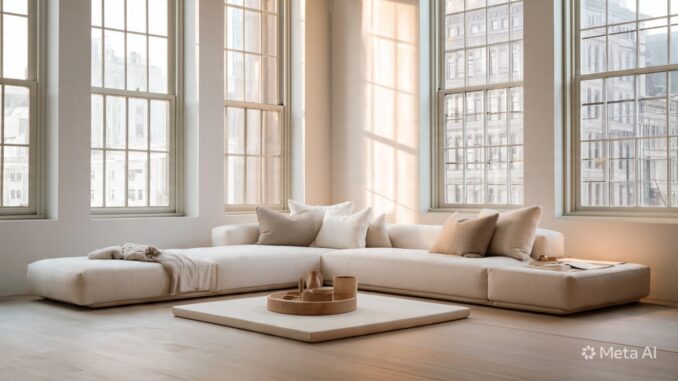
16. The Platform Sofa Look
Key features: Low, deep, legless or block-leg sofa. No skirts, no fluff.
Why it works: Hugs the ground and makes ceilings look taller. Very Japandi.
Copy it: Remove the legs from your current sofa for a week and test the vibe.

17. Single Statement Chair
Key features: One incredible chair — Eames lounge, Pierre Jeanneret, or a sculptural modern design.
Why it works: In minimalism, one great piece beats five okay pieces.
Copy it: Save for one chair you’ll keep 20 years instead of a full matching set.

18. Backless Seating
Key features: Daybed, backless bench, or chaise instead of a sofa.
Why it works: No back = no visual barrier. The room flows in all directions.
Copy it: Put a bench under a window. It seats people without blocking light.

19. Floating Furniture Only
Key features: Wall-mounted media console, floating shelves, no legs touching the floor except sofa.
Why it works: Seeing more floor creates space. It’s also easier to clean.
Copy it: Start with a floating nightstand-style side table.

20. The Monolithic Coffee Table
Key features: One chunky, solid coffee table — stone, wood block, or plaster. No legs.
Why it works: It’s functional art. You need nothing else on it.
Copy it: Avoid glass tops with stuff stored underneath. That defeats minimalism.

Detail & Styling Minimalist Designs

21. No Upper Third Styling
Key features: Keep all furniture and decor below 48” high. Walls mostly bare.
Why it works: Empty upper wall space makes 8ft ceilings feel like 10ft.
Copy it: Take everything off your mantel and shelves above eye level.

22. One Art Rule
Key features: A single oversized canvas or framed print. No gallery walls.
Why it works: One piece feels intentional. Gallery walls can read as clutter.
Copy it: Art should be 2/3 width of your sofa. Hang center at 57” from floor.

23. Hidden Tech Minimalism
Key features: Frame TV, cords in wall, no visible speakers, no cable box.
Why it works: Tech is the biggest source of visual clutter. Hide it and the room relaxes.
Copy it: Start by corralling all remotes into one closed box or drawer.

24. The Empty Coffee Table
Key features: Coffee table with literally nothing on it, or one single object.
Why it works: It’s the ultimate luxury — surface space. The table itself is the decor.
Copy it: Clear yours for 7 days. Notice how much calmer the room feels.

25. Basket-Only Storage
Key features: No open shelving. All toys, throws, and clutter go in 2–3 matching baskets.
Why it works: Baskets hide chaos but still feel textural and warm.
Copy it: Rule: if it doesn’t fit in the basket, it doesn’t live in the living room.

Minimalism for Real Life

26. Minimal With Kids
Key features: Closed storage for toys, washable slipcover sofa, round ottoman instead of table.
Why it works: Minimalism isn’t “no stuff,” it’s “contained stuff.” Kids need clear floors to play.
Copy it: Use a cabinet as a toy closet. One bin out at a time.

27. Minimal With Pets
Key features: Leather or performance fabric sofa, no white rugs, elevated pet bed that looks like furniture.
Why it works: You can’t be minimalist if you’re stressing about fur and stains 24/7.
Copy it: Choose materials first, style second. Crypton, leather, and indoor/outdoor rugs win.

28. Rental-Friendly Minimal
Key features: Peel-and-stick wallpaper removed, furniture does the work, no holes in walls.
Why it works: You can go minimal without painting or built-ins.
Copy it: A large leaning mirror + tall plant = architecture without renovation.

29. The 10-Item Living Room
Key features: Literally count: sofa, chair, coffee table, rug, lamp, curtain, art, plant, basket, side table. Stop at 10.
Why it works: Forces editing. You realize how little you actually need.
Copy it: Try it for a month. Add back only what you actively missed.

30. Minimal Maximal Art
Key features: Room is 95% simple, but one wall has a crazy colorful mural or huge tapestry.
Why it works: Minimalism is about focus. If everything is quiet, one loud thing sings.
Copy it: Keep furniture dead simple if your art or wallpaper is bold.

How to Start Doing Minimalism Tomorrow

You don’t need to buy anything to start. Do this 30-minute reset:
-
Clear every surface. Coffee table, mantel, media unit. Take it all off.
-
Remove one piece of furniture. A chair, side table, or ottoman. See how the room breathes.
-
Hide cords. Use cord covers, zip ties, or tuck them. Visual clutter = mental clutter.
-
Make the floor visible. Store or donate anything sitting directly on the floor.
-
Add one empty space. Leave one shelf, one wall, or one table completely bare on purpose.
Minimalist Commandments to Remember:
-
Quality over quantity. One good wool throw > four polyester ones.
-
Negative space is a design choice. Empty isn’t unfinished.
-
Everything needs a home. If it doesn’t have a drawer or basket, it creates clutter.
-
Texture is color. In a neutral room, bouclé, wood grain, and stone are your color palette.
-
If you don’t love it or use it, it goes. Be ruthless but not cold.
Minimalism isn’t a look. It’s a filter. Run every purchase and every object through: “Does this add calm or chaos?” If it’s chaos, out it goes.

Clean spaces aren’t about perfection. They’re about giving your eyes and brain a place to rest. And in a world that’s loud, that’s the real luxury.
Leave a Reply