Small rooms are not a design punishment. They’re a design challenge. And when you get it right, a small room feels intentional, cozy, and smarter than a sprawling space with dead zones.

The trick isn’t to just “go light and bright.” It’s to make every inch work harder. Every piece of furniture needs a job — sometimes two. Every wall, corner, and vertical inch is an opportunity. You’re not decorating less, you’re editing better.

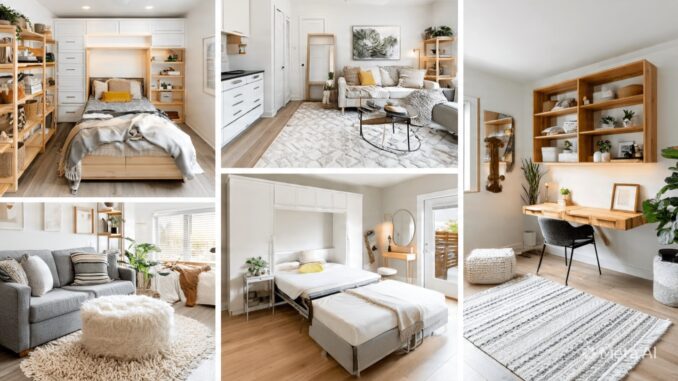
These 35 ideas apply to bedrooms, living rooms, offices, and studios. Whether you’re in 400 sq ft or just have one awkward 10x10 room, this is how you stop fighting your square footage and start using it.

The Small Room Mindset Shift

Stop asking “How do I make this look bigger?” Start asking “How do I make this work better?” Big rooms waste space. Small rooms can’t afford to. Function first. Then make it beautiful.

Layout & Floor Plan Wins

1. Float Furniture to Create Breathing Room
The look: Sofa or bed pulled 6–12” from the wall instead of shoved against it.
Why it works: A gap creates shadow and air flow. It tricks the eye into seeing depth vs a flat wall of furniture. It also makes cleaning easier.
Get the look: Even in tiny rooms, pull the bed out 4”. You’ll gain visual space and stop bumping the wall.

2. Use a Floor Plan App Before You Buy
The look: Measured layout on your phone, not guessing at the store.
Why it works: 3” too wide = doesn’t fit. In small rooms, there’s no margin for error.
Get the look: MagicPlan, Room Planner, or even graph paper. Measure doorways, windows, and outlets too.

3. Pick a Focal Point and Build Around It
The look: Bed OR TV OR window is the star. Everything else supports it.
Why it works: Small rooms can’t handle 3 focal points. It looks chaotic. One hero, rest is supporting cast.
Get the look: If the window has a view, that’s your focal. Arrange furniture to face it, not the TV.

4. Keep a 30” Walkway Minimum
The look: Clear paths between all furniture. No squeezing sideways.
Why it works: Tight walkways make a room feel stressful. You should glide, not dodge.
Get the look: Main paths need 36”. Secondary paths 24”. If you can’t do it, your furniture is too big.

5. Angle Furniture in Awkward Rooms
The look: Chair or desk at 45 degrees in a corner instead of flat on wall.
Why it works: Angles break up boxy rooms and can improve flow in weird layouts.
Get the look: Try it with one piece only. If everything is angled, it looks like a waiting room.

6. Define Zones With Rugs in Studios
The look: 5x7 rug for “living,” 4x6 for “sleep,” runner for “kitchen.”
Why it works: Rugs create rooms without walls. Visually separates functions so your studio doesn’t feel like one blob.
Get the look: Leave 12–18” of bare floor around edges so zones feel defined, not wall-to-wall.

Furniture: Size, Scale & Double Duty

7. Buy Apartment-Size Furniture
The look: 72–78” sofa instead of 90”. 28” deep instead of 40”.
Why it works: Standard furniture is designed for 2000 sq ft homes. Apartment lines are scaled for real life.
Get the look: Search “apartment sofa” or “condo size.” West Elm, Article, and CB2 do this well.

8. Go Leggy, Not Boxy
The look: Sofa, bed, and chairs with 5–7” legs showing.
Why it works: Seeing floor under furniture creates air and makes the room feel larger. Skirted/blocky pieces feel heavy.
Get the look: If you love a piece but it’s boxy, add legs. Hairpin legs are $20 and add instant lift.

9. Round Shapes Improve Flow
The look: Round coffee table, oval dining table, curved chair.
Why it works: No corners = no bruised shins and better traffic flow. Curves soften boxy rooms.
Get the look: One round piece per zone. 30–36” round coffee table is perfect for small living rooms.

10. Wall-Mount Everything You Can
The look: Floating nightstands, wall-mounted desk, floating TV console, wall sconces.
Why it works: Floor space is gold. Floating furniture shows more floor, so room feels bigger. Plus easier to vacuum.
Get the look: IKEA Lack shelves, floating Besta, or DIY a 2x10 board as a floating desk.

11. Choose Armless or Slim-Arm Seating
The look: Track arms, slipper chairs, or armless chairs.
Why it works: Rolled arms eat 12” of width. In a small sofa, that’s a whole seat.
Get the look: Slim arms give you more actual seating in the same footprint.

12. Storage Ottomans > Coffee Tables
The look: Upholstered ottoman with storage inside + tray on top.
Why it works: It’s a coffee table, extra seat, footrest, and blanket bin in one.
Get the look: Pick one with legs to keep it light. Leather or performance fabric wipes clean.

13. Nesting Tables and C-Tables
The look: 2–3 tables that tuck together. C-table slides under sofa.
Why it works: Expand when guests come, tuck away daily. C-tables give you a surface without taking floor space.
Get the look: One set of nesting tables can be side tables, coffee table, and plant stands.

14. Drop-Leaf or Gateleg Tables
The look: Dining table that’s 12” deep normally, expands to 36” for dinner.
Why it works: You get a dining room only when you need it. Rest of time, it’s a console.
Get the look: IKEA Norden is the classic. Wall-mounted drop-leaf is even better for studios.

15. Beds With Storage Drawers
The look: Platform bed with 2–4 drawers underneath.
Why it works: Under-bed is dead space otherwise. Drawers beat bins because you can access without moving everything.
Get the look: If you have a bed, add under-bed drawers on wheels. Or use bed risers + storage boxes.

16. Daybed as Sofa-Guest Bed Hybrid
The look: Daybed with back and arms in living room. Looks like sofa, sleeps 1–2.
Why it works: Studios and 1-bedrooms need living + sleeping. Daybeds do both without screaming “bedroom.”
Get the look: Style with 5–7 pillows and throw to look like sofa. Use a trundle for 2 guests.

Vertical Space: The Most Wasted Area

17. Go Floor-to-Ceiling With Storage
The look: Bookcases or cabinets that hit the ceiling, not 6ft tall.
Why it works: Uses vertical real estate and draws eye up, making ceilings feel taller.
Get the look: IKEA Billy with height extender. Or stack 2 smaller units. Paint same color as wall to recede.

18. Use Space Above Doors and Windows
The look: Shelf 12” below ceiling, running over door or window.
Why it works: It’s dead space you never look at. Perfect for books, baskets, or display.
Get the look: Use 1x10 board + brackets. Keep it 12” deep max so it doesn’t loom.

19. Hang Curtains High and Wide
The look: Rod 4–6” from ceiling, extending 8–12” past window sides.
Why it works: Makes windows look massive and ceilings taller. Standard “on the frame” hanging chops the wall.
Get the look: 96” or 108” panels even with 8ft ceilings. Pool 1” for relaxed look.

20. Vertical Wall Storage in Kitchen/Bath
The look: Pegboard, magnetic knife strip, or rail system on wall.
Why it works: Frees counter space. In small kitchens, counter space is everything.
Get the look: IKEA Skadis pegboard or basic rail with S-hooks. Use it for utensils, mugs, or plants.

21. Loft It If Ceilings Allow
The look: Loft bed with desk or sofa underneath. Only if you have 9ft+ ceilings.
Why it works: Doubles your square footage. Floor under becomes new room.
Get the look: Check code: 30” clearance above mattress minimum. Not for kids under 6. Adults need a real ladder.

Visual Tricks That Actually Work

22. One Big Rug > Several Small Rugs
The look: 8x10 or 9x12 rug where all key furniture legs sit on it.
Why it works: Small rugs chop up the room. Large rug unifies it and makes it feel expansive.
Get the look: In living room, all front legs on rug minimum. In bedroom, rug should extend 24–36” on sides of bed.

23. Use Large-Scale Art, Not Gallery Walls
The look: One 30x40” piece instead of 8 small frames.
Why it works: Too many small things = visual clutter. One big piece simplifies and anchors.
Get the look: Hang center at 57–60” from floor. Art should be 2/3 width of furniture below it.

24. Mirrors to Double Light and Space
The look: Large mirror opposite or adjacent to window.
Why it works: Reflects light and view. Oldest trick because it works.
Get the look: Go big — 3x5ft minimum. Leaning floor mirror makes ceilings feel taller. Round softens corners.

25. Paint Trim Same Color as Walls
The look: Walls, trim, and baseboards all one color. Different sheens only — flat walls, satin trim.
Why it works: Eliminates visual breaks. Lines chop up space. One color = seamless and larger.
Get the look: Best with light to mid-tone neutrals. Dark colors can work too for moody cocoon.

26. Glass and Acrylic for Visual Lightness
The look: Glass coffee table, acrylic chairs, or open metal shelves.
Why it works: You see through it, so it takes up less visual space.
Get the look: Use one only. All-glass room feels cold. Pair with warm wood and textile.

27. Stripe Trick for Height or Width
The look: Vertical stripe wallpaper or paneling to add height. Horizontal shiplap to add width.
Why it works: Lines direct the eye. Vertical = taller. Horizontal = wider.
Get the look: Keep stripes tone-on-tone so it’s subtle. High-contrast stripes can feel busy.

Storage & Decluttering Rules

28. Closed Storage > Open Storage
The look: Cabinets, baskets with lids, dressers vs all open shelves.
Why it works: Visual clutter reads as physical clutter. Doors hide chaos.
Get the look: Aim for 70% closed, 30% open. Style open shelves with 1/3 books, 1/3 objects, 1/3 empty space.

29. Use the Backs of Doors
The look: Over-door rack, hooks, or shoe organizer.
Why it works: 20 sq ft of free storage per door. Use it for shoes, jewelry, cleaning supplies, or pantry.
Get the look: Clear pockets so you see what’s there. Cut bottoms if items are long.

30. One In, One Out Rule
The look: For every new thing, one old thing gets donated.
Why it works: Small spaces can’t handle accumulation. This keeps volume stable.
Get the look: Keep a donation box in closet. When full, drop off. No guilt.

31. Corral Surface Clutter on Trays
The look: Tray on coffee table, dresser, and entry. All small items live there.
Why it works: Boundaries make mess look intentional. If it’s not on the tray, it gets put away.
Get the look: Use different shapes — round, rectangle — to define zones.

Light & Color

32. Layer Lighting, Ditch the Overhead
The look: Floor lamp + table lamp + sconces. Overhead off most of time.
Why it works: Overheads cast shadows and feel harsh. Multiple low sources add depth and coziness.
Get the look: 3 light sources per room minimum. All 2700K warm bulbs. Dimmers if possible.

33. Light Colors Aren’t Mandatory
The look: Dark navy, charcoal, or deep green in small room.
Why it works: Dark colors blur edges and recede. A dark room can feel bigger, not smaller, if lit well.
Get the look: If you go dark, use lots of lamps, light rug, and light art. Contrast is key.

34. Keep Ceiling White or Lighter Than Walls
The look: Even with dark walls, ceiling is white or 50% lighter.
Why it works: Lifts the ceiling visually. Dark ceilings cave in unless you have 10ft+.
Get the look: Flat paint only on ceilings. Gloss shows flaws.

35. Monochrome Palette = Calm
The look: Varying shades of one color — all warm whites, all greiges, all blues.
Why it works: No harsh contrast = restful. Your eye moves smoothly, so room feels larger.
Get the look: Pick 3–4 shades of one color. Use texture to add interest: linen, wool, wood, ceramic.

Small Room Mistakes That Make It Feel Smaller
-
Too-small rug: Chops up floor. Go big or go home.
-
Too much furniture: If you can’t walk around it, you have too much.
-
All small decor: Lots of tiny items = clutter. Go fewer, larger pieces.
-
Pushing everything to walls: Creates dead space in middle. Float pieces.
-
Blocking natural light: Heavy curtains or furniture in front of windows.
-
Cool, harsh lighting: 5000K bulbs make it feel like an office.
The Small Room Formula
-
Edit: Remove 20% of what’s in there. If you haven’t used it in 6 months, store or donate.
-
Elevate: Legs on furniture, mount stuff to walls, hang curtains high.
-
Unify: One big rug, limited color palette, matching hangers.
-
Double-duty: Every piece earns its footprint with 2+ functions.
-
Vertical: Use walls and height. Floor space is precious.
Small rooms force you to be intentional. There’s no space for “maybe someday” stuff or furniture you don’t love. But when done right, small rooms are the coziest, most efficient, and most personal spaces in a home.

You don’t need more square footage. You need smarter square footage. Start with one zone — clear it, measure it, and put back only what works. The rest of the room will follow.
Leave a Reply